Food systems are major contributors to climate change and highly vulnerable to its impacts, threatening global agricultural productivity, livelihoods, and food security worldwide.
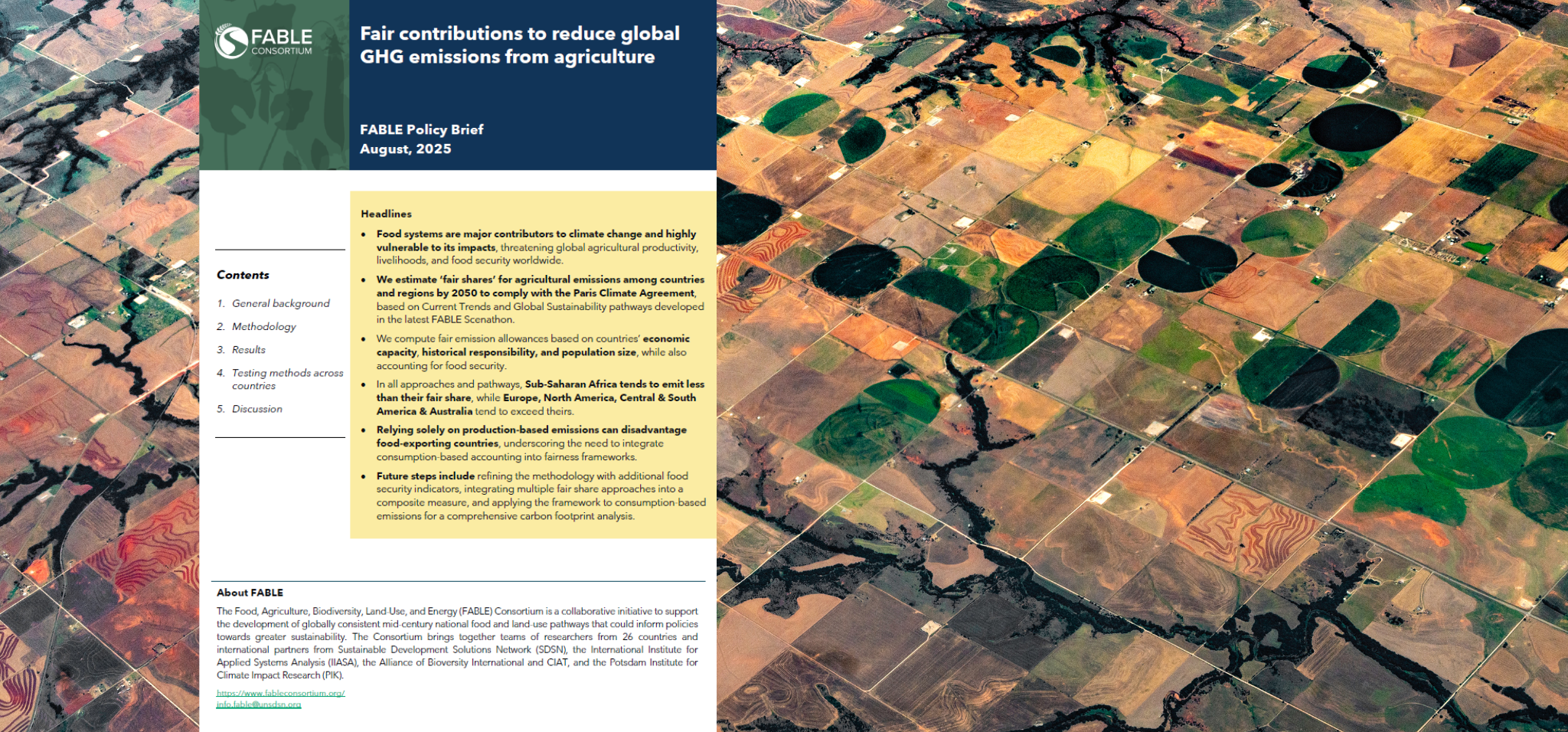
The latest FABLE policy brief, Fair contributions to reduce global GHG emissions from agriculture, introduces a framework to assess equity in agricultural emission reductions, based on the Paris Agreement’s principle of 'common but differentiated responsibilities and respective capabilities.'
Drawing on the 2023 Scenathon results and the long-term pathways for food and land-use systems developed for 22 countries and 6 regions, the brief presents estimated fair share allowances to 2050, using three equity-based approaches: ability to pay, historical responsibility, and population size. These allowances are adjusted using yield gap and self-sufficiency ratio indicators to ensure food security while reducing agricultural emissions.
The results show that Europe, North America & Australia, and Central & South America remain far from meeting their fair share across all pathways and equity approaches. Under Current Trends, only Sub-Saharan Africa meets its fair share under the ability to pay principle. In the Global Sustainability scenario, Asia meets its fair share under the historical responsibility principle, as well as North Africa & the Middle East under both historical responsibility and population-based approaches.
We find that production-based emissions accounting can unfairly penalize food-exporting countries, making a strong case for integrating consumption-based accounting into fairness frameworks. Future steps include refining the methodology with additional food security indicators, integrating multiple fair share approaches into a composite measure, and applying the framework to consumption-based emissions for a comprehensive carbon footprint analysis.
This policy brief was developed as part of the 2050 is now: Aligning climate action with long-term climate and development goals.