
Authors: Katia Michalopoulos, Heikki Lehtonen.
Changes to food systems rarely affect just one part of the system. A policy aimed at improving sustainability or reducing emissions can ripple outward — often in cascading and uncertain ways — reshaping livelihoods, access to food, and power relations.
Within food systems, systemic components of ecological sustainability and social justice are intertwined on an essential level. Food systems are shaped by ecological processes, economic structures, cultural practices, and political choices, making them difficult to address through any single lens. To understand these complex and subtle dynamics, research approaches must move beyond disciplinary boundaries, remaining sensitive to these realities and seeking opportunities for holistic transformation that recognizes all sides.
Transdisciplinary research responds to this challenge by bringing together different types of knowledge to tackle complex sustainability problems. Rather than treating the social and economic impacts of climate action as obstacles, this perspective sees them as entry points for developing more integrated and equitable solutions.
The Justice Questions That Climate Targets Can’t Answer
Once justice is taken seriously in food systems transformation, several fundamental questions emerge. Where do systemic interactions and in/justices exist within our current food systems, and how do they manifest across different contexts? How do visions of “just” food systems differ, and which justice questions need to be resolved to achieve climate targets? And how can transformation pathways be designed in ways that give recognition to the most vulnerable groups?
The recent paper “Deliberating justice in food systems transformation pathways: a transdisciplinary approach applied in Finland” published in Environmental Research: Food Systems, engages directly with these questions. The paper was authored by Prof. Minna Kaljonen from the Finnish Environment Institute, Heikki Lehtonen, from the Natural Resources Institute Finland (Luke) and FABLE Finland, together with a wider group of researchers. The authors propose a transdisciplinary framework for deliberating just food systems transformation pathways, grounded in the idea that justice considerations can be systematically incorporated into the design and evaluation of transformation processes. The paper explores how this can be done in practice, detailing experiences gained in applying this methodology to the Finnish food system.
The findings suggest that justice frameworks can help bring together different disciplines and food system actors to create a shared language for food systems transformation. At the same time, they make visible conflicting interests and trade-offs that require ethical reflection by researchers and other societal actors.
The Normative Compass Framework
At the center of the approach is the introduction of a normative compass — a shared set of justice-oriented questions introduced as a boundary object, weaving together transdisciplinary knowledge built from different disciplines and stakeholder groups. This specific set of questions can help identify and weigh justice issues.
The questions are grounded in a multidimensional understanding of justice, encompassing distributive, procedural, and recognitional dimensions common in environmental justice theories. The principles also pay specific attention to the capacities and the recipients of justice, including global fairness, intergenerational justice, ecology, and non-human beings.
The methods were developed throughout the 6-year transdisciplinary Just food project in Finland, which explored and developed pathways for a just transformation to a sustainable, healthy, and climate-neutral food system. Funded by the Strategic Research Council of Finland, the project brought together interdisciplinary expertise from food systems studies, philosophy, social sciences, environmental sciences, agricultural economics and nutrition. It also engaged a wide range of stakeholders in deliberating possible transformation pathways.
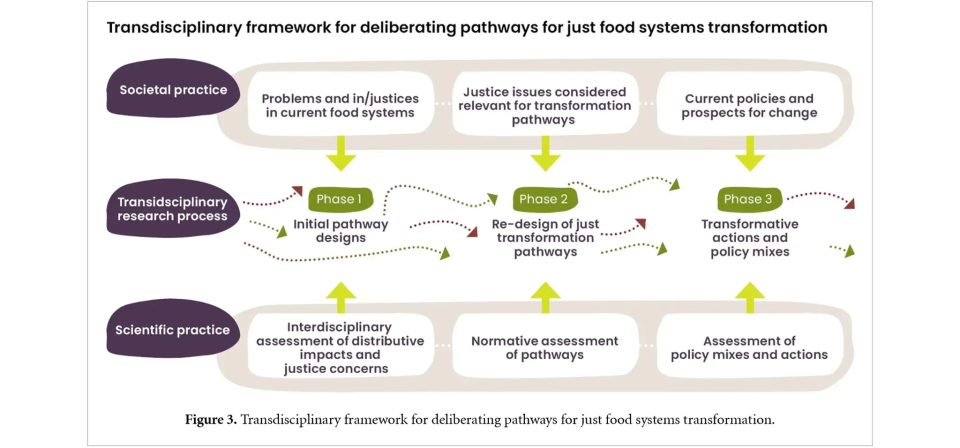
The process was conducted in three phases. In the first phase, initial pathways were co-designed to better understand food system in/justices, while considering potential partners for their resolution. In the second phase, relevant justice considerations were explored in greater depth using the normative compass, which helped policy dialogue participants to identify the specific justice concerns related to each of the pathways. In the final phase, participants identified transformative actions and policy options.
Across these phases, justice principles and criteria were useful for researchers from different disciplines to investigate multiple dimensions of justice, and for societal actors to develop their arguments on what can be considered as just in their transformation strategies.
Key Insights from the Finnish Case
The Finnish case highlights that deliberating just food systems transformation pathways is not a linear or straightforward process. Justice can be a unifying language to foster dialogue and develop shared understandings, but it can also reveal conflicts, competing interests, and ethical dilemmas.
Crucially, this methodology shows that justice considerations cannot be addressed once and set aside; they must be revisited iteratively as pathways evolve. An iterative transdisciplinary approach allows for return assessments on justice implications, ensuring that the co-designing of pathways remains societally fair. The normative compass introduced here offers one route for introducing ethical reflection to the deliberation of just transformation pathways.
While Finland represents an affluent welfare society in the Global North, the findings point to the need for context-sensitive approaches elsewhere, particularly in settings marked by deeper structural inequalities. In the case of Finland, we found that the potential distributive impacts due to transitions towards low-carbon food system may vary greatly according to geographic location and production possibilities of farms, as well as the structure of food industry and services in the region.
What remains clear is that explicit evaluation and articulation of justice concerns is urgently needed in transformative food systems research. In future, a well-balanced mix of short- and long-term actions is required to co-produce transformative change while extending the group of engaged actors to address deeper vulnerabilities. This invites transformative research to develop novel procedural and methodological approaches for ethical reflection.
This blog is based on the paper “Deliberating justice in food systems transformation pathways: a transdisciplinary approach applied in Finland” published in Environmental Research (2025).