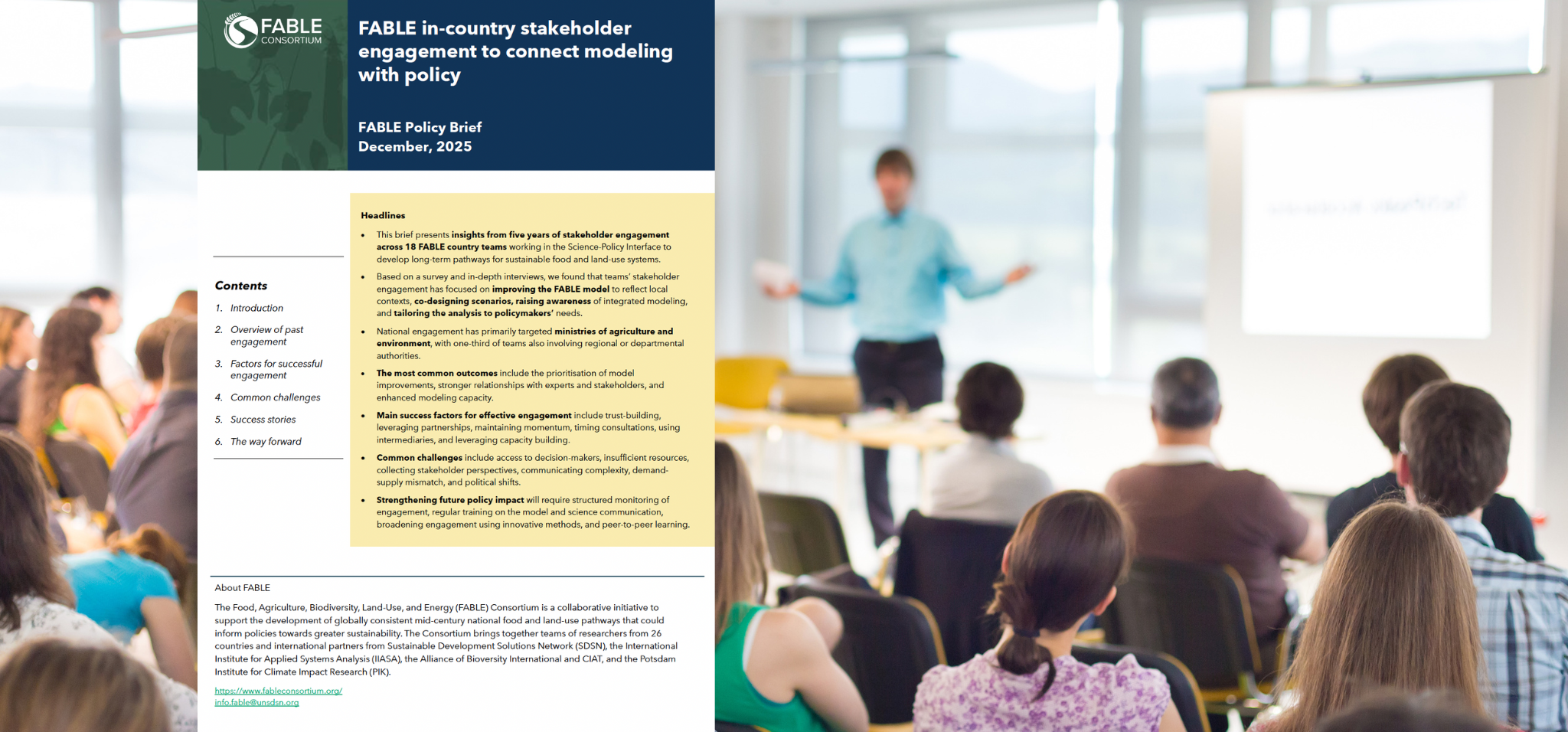
This brief examines stakeholder engagement experiences from the FABLE Consortium, a global network of country-led research teams developing integrated pathways for sustainable food and land-use systems. Consistent with its decentralized approach, teams designed their own engagement strategies, resulting in a wide diversity of practices across national contexts.
Based on a survey and interviews, we identified common enabling factors and challenges from among 18 country teams engaging stakeholders. We found that across countries, engagement has focused on improving the FABLE model to reflect local contexts, co-designing policy-relevant scenarios, and raising awareness of integrated modeling, primarily with ministries of agriculture and environment.
Effective engagement relies on trust-building, leveraging partnerships, maintaining momentum, timing consultations, using intermediaries, and leveraging capacity building. Common challenges include access to decision-makers, insufficient resources, collecting stakeholder perspectives, communicating complexity, demand-supply mismatch, and political shifts.
Based on recommendations from country teams, the literature, and other successful initiatives, we propose actions to strengthen future policy impact for FABLE country teams and similar research initiatives. These include structured monitoring of engagement, regular training on the model and science communication, broader engagement through innovative methods, and peer-to-peer learning.
This policy brief was developed as part of the 2050 is now: Aligning climate action with long-term climate and development goals.