Authors: Juliana Arbelaez-Gaviria, Miroslav Trnka.
Recent climate change impact assessments increasingly recognize that agriculture does not respond to climate change in isolation. Market dynamics, trade, and cross-border climate impacts shape national outcomes in ways that are often overlooked. In a new study focusing on the Czech Republic, we explore how incorporating global agricultural and economic interactions into national assessments can substantially change our understanding of climate risks and adaptation potential.
Using an integrated assessment framework that combines global crop modelling with economic and trade analysis, the study shows that assessments limited to national climate impacts may misrepresent both vulnerabilities and opportunities for adaptation. By situating Czech agriculture within a global context, the analysis highlights the importance of autonomous adaptation mechanisms that emerge through markets and land-use decisions.
Context: Why Scale Matters For Agricultural Adaptation
Agriculture in Central Europe plays an important role in food security, rural livelihoods, and land-based climate mitigation. In the Czech Republic, crop production is strongly integrated into European and global markets, with trade shaping prices, production decisions, and competitiveness. At the same time, climate change is projected to affect crop yields unevenly across regions, creating winners and losers at multiple spatial scales.
Most national climate change impact assessments in the region have focused on local biophysical impacts, such as changes in productivity of the most relevant crops for the country, such as wheat, barley, and rapeseed. While these assessments provide valuable insights, they often overlook how climate impacts occurring elsewhere are transmitted through trade and markets. This raises a key question: To what extent do national-only assessments capture the full spectrum of climate risks and adaptation responses?
Addressing this question is central to the objectives of global initiatives such as FABLE, which aim to link national pathways to global dynamics in food, land use, and climate action.
Moving Beyond National-Only Assessments
To explore the limitations of country-scale assessments, we compared climate impact scenarios applied at three different levels: national, regional (European), and global. In all cases, the same autonomous adaptation mechanisms were available, allowing markets and producers to respond endogenously to changing conditions.
By embedding the Czech Republic within a globally consistent modelling framework, the analysis captures how climate impacts outside national borders influence domestic outcomes through price signals, trade flows, and shifts in comparative advantage. This approach represents a novel effort in Central Europe, where state-of-the-art models commonly used in global climate change assessments have rarely been applied to country-level decision-making.
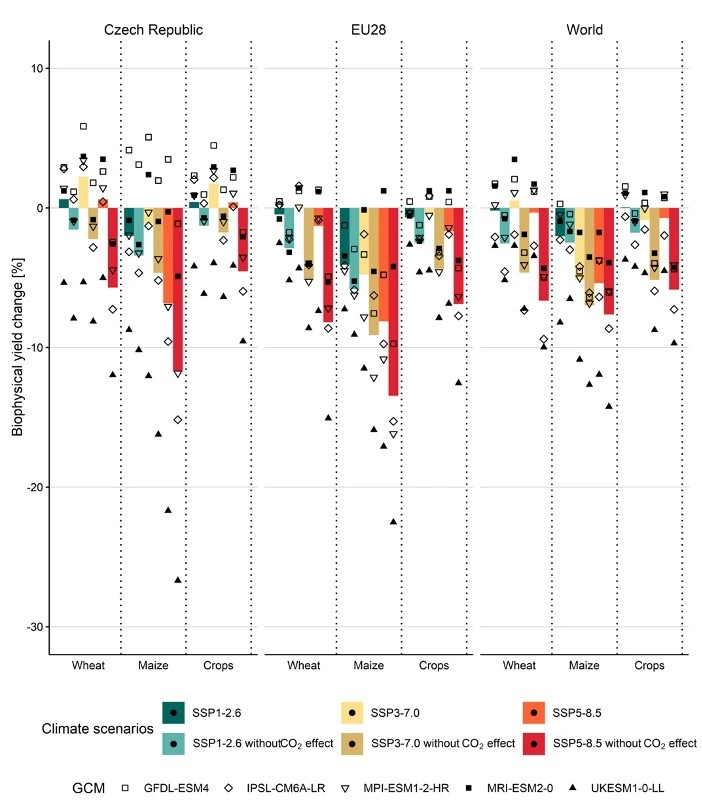
The results show that focusing exclusively on national climate impacts can overstate local production losses and understate the buffering role of global markets. When climate impacts are considered globally, autonomous responses—such as land reallocation and trade adjustments—significantly alter national production and trade patterns.
Autonomous Adaptation as a System-Level Response
A key insight from the analysis is the importance of autonomous adaptation mechanisms. Rather than relying solely on planned policy interventions, agricultural systems respond to climate change through decentralized decisions by farmers and market actors. These responses include adjustments in land use, shifts between production systems, and changes in import–export patterns.
Land expansion emerged as an important short-term response under global impact scenarios, reflecting favorable conditions in parts of Central Europe relative to other regions in Europe. However, this strategy is constrained by environmental considerations, land-use regulations, and broader sustainability objectives. As a result, autonomous adaptation alone cannot guarantee long-term resilience.
These findings underline the need to interpret autonomous adaptation not as a substitute for policy, but as a dynamic process that interacts with regulatory frameworks, environmental limits, and strategic planning.
Implications For Policy and National Pathways
The study highlights important implications for climate adaptation planning in small, open economies. National-only assessments risk maladaptation by overstating self-sufficiency and underestimating the role of international linkages. In contrast, multilevel assessments provide a more realistic basis for designing policies that account for transboundary climate risks and economic feedbacks.
For initiatives such as FABLE, which aim to support national food and land-use pathways aligned with global climate goals, these results reinforce the value of globally consistent modelling approaches. Integrating trade and market dynamics into national assessments can help policymakers better anticipate unintended consequences, distributional effects, and trade-offs between adaptation, mitigation, and environmental protection.
This work builds on long-term collaboration between Czech research institutions and international modelling teams working on climate impacts, adaptation, and mitigation strategies in Europe. Such cooperation is essential for translating global modelling tools into nationally relevant insights. However, fostering dialogue between modellers and local policymakers remains a critical step toward more actionable climate assessments.
This blog is based on the paper “National climate change impact assessments underestimatethe potential of autonomous adaptation” published in Regional Environmental Change (2026).