Authors: Kalkidan Mulatu and Charlotte Chemarin (Alliance Bioversity International & CIAT).
Context
Agriculture plays a focal role in Ethiopia’s employment, economy, food security and climate change mitigation and adaptation efforts. The country is still facing important challenges with regard to food security with around 60% of the population experiencing moderate or severe food insecurity over the last years according to FAOSTAT. At the same time, 80% of the national greenhouse gas (GHG) emissions originate from the agricultural and land sectors, particularly due to land conversion and livestock. Transforming the agricultural sector is critical for attaining the country’s food and climate targets.
Several policy documents state targets for reduced emissions and improved productivity such as the 10-Year Development Plan in 2020 and the last Long-Term Low-Emissions Development Strategy (LT-LEDS) in 2023. Additionally, Ethiopia launched the Ethiopia Food Systems Transformation and Nutrition (EFSTN) process in 2020, a concerted effort for shaping a comprehensive food system strategy gathering multi-sector stakeholders. This framework identifies game changing solutions to build an inclusive and resilient food system that guarantees access to safe and diverse food while preserving land and increasing climate resilience.
During COP 28 in 2023, FAO launched the FAO Global Roadmap achieve food security and nutrition in the context of climate actions. Based on its framework, the FABLE Ethiopia team developed an illustrative integrated pathway to explore synergies between food and climate agendas with the support of the FABLE Secretariat and FAO.
Strong ambitions and large set of levers
The Policy Studies Institute (PSI), an Ethiopian government policy research think-tank, led the review of more than 60 official documents to extract commitments in the food and land use domains. To sort out key actions and prioritize them, we mapped those national commitments against the 120 high-impact actions indentified in the FAO Global Roadmap framework as key levers to transform and achieve global food targets under SDG2, while keeping global warming below 1.5°C as set by the Paris Agreement.
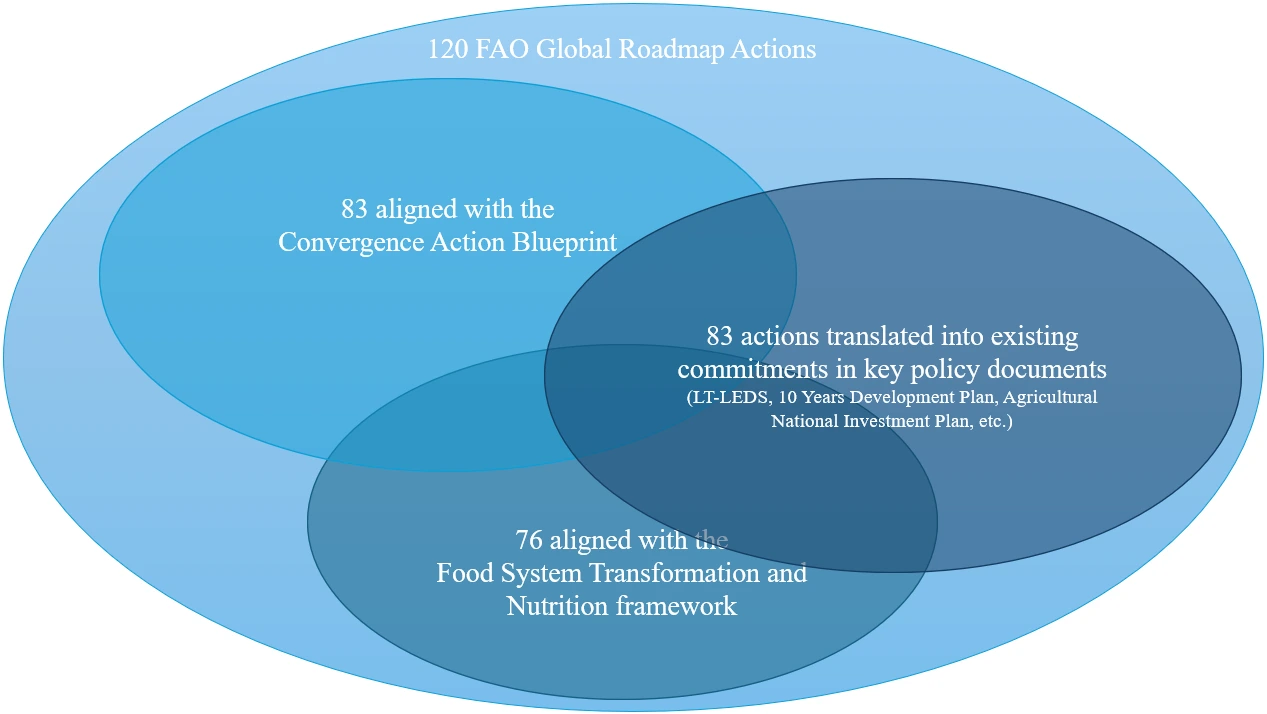
Most FAO Global Roadmap actions aligned with the Ethiopin Food System Transformation and Nutrition pathway, the Convergence Action Blueprint or key national policies when not the three (Figure 1). This demonstrates a good integration of challenges and potential solutions.
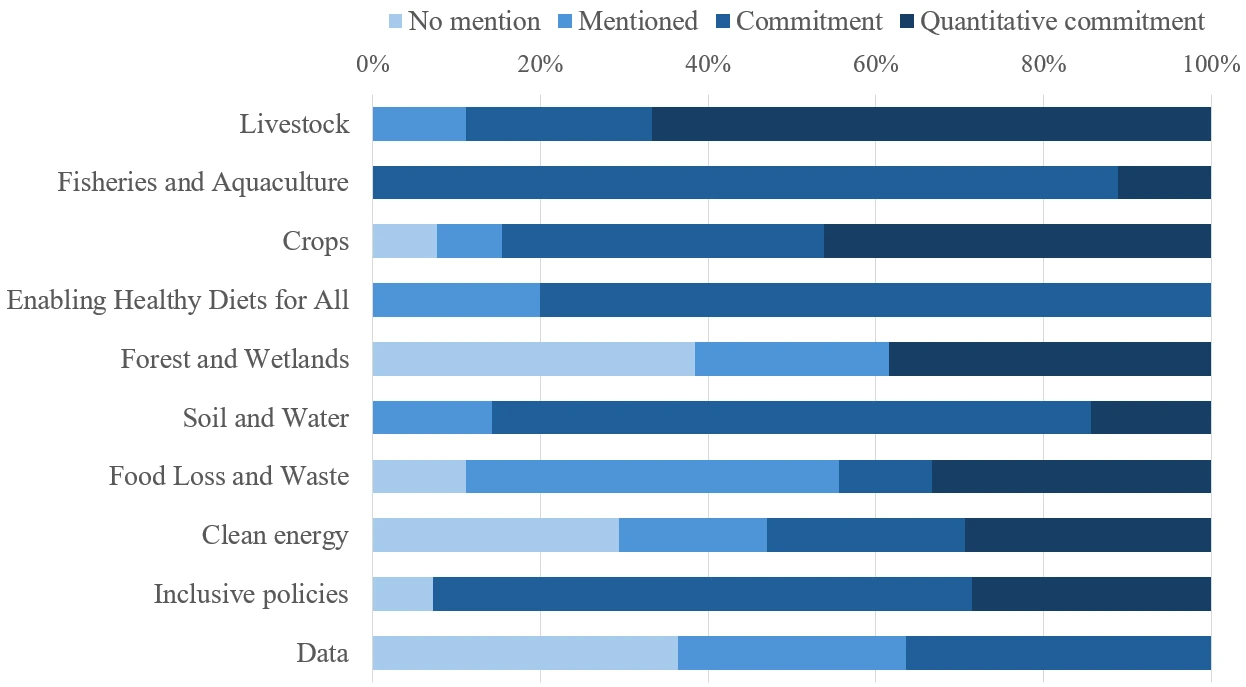
While the Ethiopian government is committed to act on all the twelve domains identified by FAO, there is still limited quantitative time-bounded targets in some domains. Most actions with quantitative targets relate to strategies enhancing productivity of crops and livestock and afforestation or restoration plans. For instance, even if the government has strongly committed to make healthy food accessible and affordable for all, we did not find clear time-bounded actions related to Enabling Healthy Diets for All which may highlight a lack of strategy to translate commitments into actions.
Development of a figurative integrated pathway
Based on this review, we developed an integrated food and land use pathway towards 2050 using the FABLE Calculator to illustrate how Ethiopia’s ambitions could be achieved. We selected a set of key actions to be modeled based on several criteria. Actions had to: 1) be mentioned in more than one policy document, 2) have a time-bounded targeted objective, 3) lay on accessible data, 4) necessitate manageable changes or improvements in the FABLE Calculator to be modelled. Actions with high policy priority and high modelling easiness included:
- Adoption of the nationally recommended healthy diet including a shift towards poultry products
- Increase in productivity for key crops (barley, coffee, corn, rapeseed, sorghum, teff and wheat)
- Adoption of climate-smart agriculture practices especially integrated soil fertility management (ISFM)
- Expansion of irrigation schemes
- Increase in animal productivity
- Expansion of dairy commercial production systems over smallholder production systems
- Afforestation and Forest restoration plans
- Extension of protected areas
Ahead of the modelling, input data on historical implementation (e.g. areas under climate-smart practices in 2020) and impact parameters (e.g. expected impact of switching from smallholder to commercial dairy systems on gas emissions per head) was compiled in collaboration with local experts. The national recommended diet of the Food Based Dietary Guidelines (2022) was further disaggregated into calories per food group of the FABLE Calculator based on a consultation with Tesfaye H. Bekele (PhD) who contributed to the development of those guidelines. New scenarios and modules in the FABLE Calculator were developed to represent selected actions, e.g. tailored productivity scenarios to align with the 10-Years Development Plan targets, modules to use official GHG emissions factors or to model the impact of switching livestock systems.
A feasible reconciliation of the food and climate agendas
The illustrative pathway of Ethiopia’s national commitments demonstrates the feasibility of ensuring access to healthy diets for all through an increase in crop and livestock production quantities and diversification of diets while transforming the AFOLU sector into a carbon net sink. The pathway relies on ambitious yield increases, made possible through orrigation, climate-smart agriculture practices, improved seeds, weather and climate early warning systems, fertilizers, mechanization and extension services and trainings. Limited expansion of agricultural areas combined with large afforestation, reforestation and forest restoration plans could lead to great amounts of carbon sequestration, mitigating emissions from crops and livestock. Gains in livestock productivity, notably due to improved veterinary services and transition to commercial systems, and adoption of a healthy diet mainly based on non-ruminant animal protein also contribute to meeting both food and climate goals.
The modelling exercise has demonstrated that strategies identified by the government could be efficient enough to achieve food security and nutrition while coping with climate change. Nevertheless, they demand major investments and coordinated efforts to translate into tangible results.
Importance of quality data and stakeholder validation
The modelling exercise revealed issues related to data gaps and inconsistencies in national records. Some actions could not be modeled due to the lack of data on current trends or insufficient information available on impact parameters. For instance, to our knowledge, no consistent nationally reported land transition matrix exists for the full period 2000-2020. National estimates on manure management, grazing practices and feed composition are also missing, such as estimates on what would be the impacts of altering those. Similarly, inconsistencies in concept definitions such as stages of production and consumption included or not into food loss estimates or definitions of dairy vs non-dairy cattle made the reconciliation of global and national datasets impossible.
Relevance to national processes
Our illustrative pathway relies on actions from policy documents but considering the large number of national policies and commitments, there is a need to hold consultation with national policy stakeholders across sectors for informed prioritization of actions and validation of outcomes. Such illustrative modeling exercises can support national processes such as the ongoing efforts of the Ethiopia Food Systems Transformation and Nutrition committee. They have started to consistently identify interventions for each game changing solution and to associate budget, target and expected outcomes. This work would be greatly beneficial for tracking progress towards food security goals and could feed further modelling work. Finally, as the Government revises its NDC, there is a timely opportunity to draw on this illustrative and quantitative evidence to refine targets, clarify pathways, and more ambitiously integrate food, nutrition, and climate objectives within the AFOLU sector.