Authors: Fernando Orduna, Charlotte Chemarin, Sarah K. Jones (FABLE Secretariat)
The FABLE Consortium is proud to have contributed to the newly released EAT–Lancet 2.0 report, which updates global targets for achieving healthy diets within planetary boundaries. Through the FABLE Calculator modelling tool and collaborative Scenathon process and infrastructure, FABLE provided new evidence on how ecological intensification and sustainable food system trajectory can feed the world, restore biodiversity, and support climate objectives globally. The publication underscores FABLE’s central role in integrating national modeling efforts to inform global strategies for transforming food and land-use systems.
Eat-Lancet 2.0 report
At the Stockholm Food Forum in early October, EAT-Lancet Commission on Healthy, Sustainable, and Just Food Systems, comprising leading international experts in nutrition, climate, economics, health, social sciences and agriculture from more than 35 countries across six continents, launched the Eat-Lancet 2.0 report. The Commission points out that global food systems are exceeding key planetary boundaries — food production and consumption account for about 30% of global greenhouse-gas (GHG) emissions and are the largest contributor to five major Earth-system transgressions, yet fewer than 1% of people currently live in a “safe and just” food-system space. Nevertheless, shifting diets and transforming food systems could prevent up to 15 million premature deaths annually and yield multi-trillion-dollar benefits for health, equity, and the planet. Achieving these goals requires urgent policy action, dietary consumption transformation, and a realignment of global financial incentives to support just, resilient, and sustainable food systems. Integrating ecological intensification within sustainable food system pathways is one of those promising solutions to reduce the environmental footprint of food production and FABLE’s contribution helped build the case.
Key contributions and findings from FABLE
As the FABLE Calculator differentiates between types of agricultural practices used on croplands, it can be used to explore the effects of scaling ecological intensification practices. Here, ecological intensification represents crop and non-crop diversification, including intercropping, cover crops, crop rotations, agroforestry, cultivar mixtures, and embedding natural vegetation into cropped landscapes. We modelled the effect of continuing current trends (with the business-as-usual [BAU] scenario) versus expanding ecological intensification practices across all croplands by 2050, in combination with the EAT–Lancet population growth, diet, productivity, and food loss and waste assumptions as featured by 10 global models.
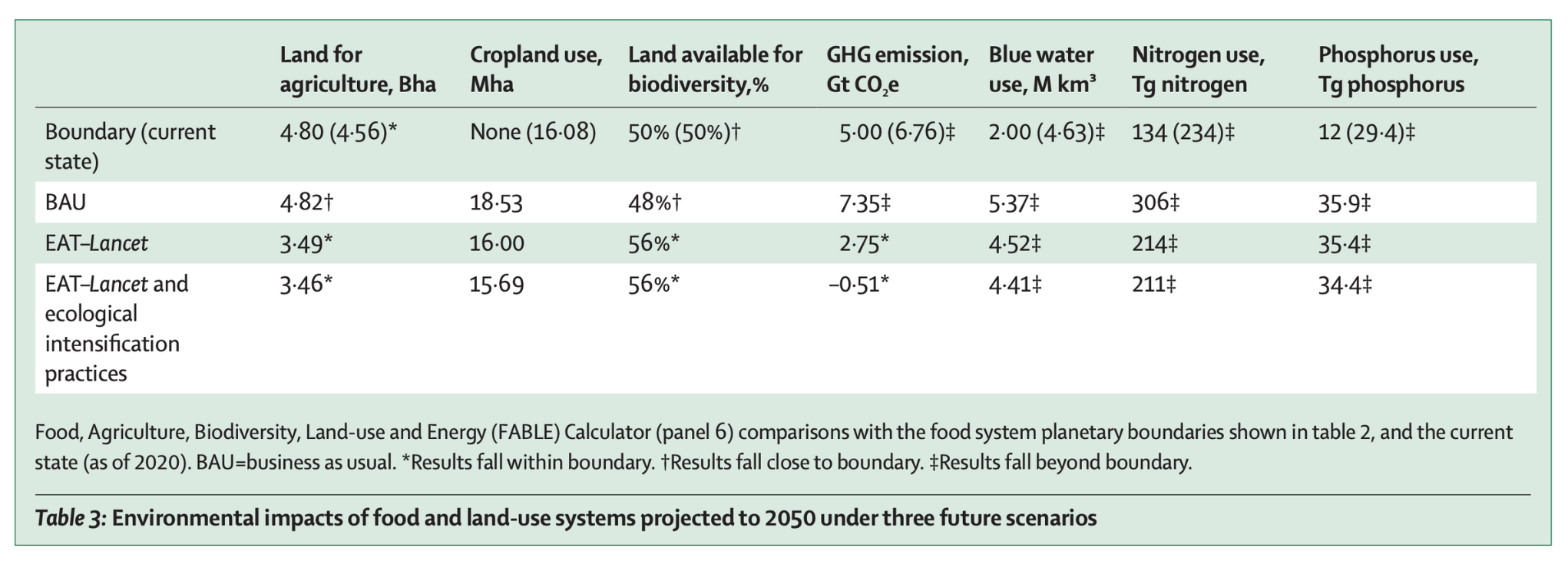
Table 3 below summarizes the projected environmental impacts of global food and land-use systems to 2050 under three scenarios modeled with the FABLE Calculator. It highlights how combining the EAT–Lancet 2.0 assumptions with ecological intensification practices can dramatically improve outcomes for land use, biodiversity, and emissions compared to a BAU trajectory:
- BAU: Under a BAU trajectory, global food systems are projected to exceed safe boundaries for land, biodiversity, greenhouse gas (GHG) emissions, water, and nutrient use by 2050.
- EAT–Lancet: Combining the adoption of the EAT-Lancet diet with reduced food waste and improved productivity keeps the food system within planetary boundaries for land use, biodiversity, and GHG emissions, although challenges remain for water and nutrient use. Annual GHG emissions from the AFOLU sector decline by 60% by 2050 compared to BAU. Moreover, reduced land pressure creates opportunities for natural habitat recovery and biodiversity conservation.
- Ecological intensification: with the EAT–Lancet 2.0 pathway, the adoption of ecological intensification principles across all croplands further increases carbon sequestration, effectively turning the AFOLU sector into a net carbon sink (–0.51 Gt CO₂e) without compromising food security. Emission reductions are driven by increased sequestration on croplands (in soil) and, to a lesser extent, by the additional conversion of agricultural land to other uses resulting from productivity gains in certain commodities.
- These results demonstrate the transformative potential of combining global dietary shifts with ecological intensification. With local adaptation and stakeholder engagement, such strategies could guide the transition toward a net-zero and nature-positive food system.
Methodology
The FABLE contribution to the EAT–Lancet 2.0 report was developed within the FABLE Secretariat in collaboration with the Alliance Bioversity International and CIAT, the International Institute for Applied Systems Analysis (IIASA), and the Sustainable Development Solutions Network (SDSN). We used the final national and region FABLE Calculators jointly created by 22 FABLE teams during the Scenathon 2023 and created additional pathways with the EAT–Lancet 2.0 assumptions — adoption of healthier diet, reduced food waste, and improved productivity — together with ecological intensification practices using the agroecology module. These pathways were analyzed through FABLE’s sensitivity tools and aggregated via the Scenathon infrastructure to align trade. It represents the first global exercise of its kind within the FABLE framework.
Find FABLE’s insights in Section 2 of the report, The EAT–Lancet Commission on healthy, sustainable, and just food systems.